
If you have been researching garage conversion cost Woodland Hills homeowners are quoted, you have probably seen numbers ranging from 80,000 dollars to well over 250,000. Both can be true, because a garage conversion is really three projects in one: making an old structure habitable, building a small kitchen and bathroom, and connecting a second dwelling to your utilities.
We build garage conversions across Woodland Hills and the West Valley, many within a few minutes of our Ventura Boulevard office. This guide breaks down the real budget tiers we see, the line items that move the number most, and the costs that hide in 1950s and 60s garages until demo day.
What Does a Garage Conversion Cost in Woodland Hills?
For a typical two-car garage of roughly 400 square feet, most Woodland Hills projects land in one of three tiers. These are typical Los Angeles area ranges that vary with scope and site conditions, not quotes.
- Studio conversion, 110,000 to 150,000 dollars. Insulation, drywall, flooring, mini-split HVAC, a bathroom, and a kitchenette along one wall. The fastest path to a legal rentable unit.
- One-bedroom ADU, 150,000 to 210,000 dollars. A framed bedroom wall, a full kitchen with appliances, upgraded finishes, and usually a new electrical subpanel.
- Conversion plus expansion, 210,000 to 280,000 dollars. The garage footprint grows with a small addition, which adds foundation work, new roof framing, and more complex structural engineering.
Per square foot, conversions usually run 300 to 500 dollars in our market. That is less than a ground-up ADU build because the slab, walls, and roof already exist, but the existing structure is also where surprises live.
The Line Items That Drive the Number
Two conversions with the same floor plan can differ by 60,000 dollars. In our projects, these six line items explain most of the spread.
- Kitchen scope. A kitchenette with a two-burner cooktop costs a fraction of a full kitchen with stone counters and a dishwasher.
- Electrical service. Many Valley homes still run 100-amp panels. A second dwelling usually means a panel upgrade or a dedicated subpanel.
- Sewer connection. Cost scales with the distance from the garage to your lateral and whether the run crosses hardscape.
- Windows and doors. Replacing the garage door with a framed wall, plus egress windows that meet code.
- Bathroom finishes. Tile showers with niches and frameless glass sit at the top of the range; fiberglass surrounds at the bottom.
- Design and permits. Plans, Title 24 energy calcs, structural engineering, and city fees typically total 12,000 to 20,000 dollars.
Permits and Fees: What LADBS Requires
Woodland Hills is part of the City of Los Angeles, so your conversion goes through LADBS plan check and inspections. California ADU law works in your favor here: the state requires cities to review complete ADU applications within 60 days, and converted garages are generally exempt from new setback requirements because the structure already exists.
Budget for plan check and permit fees, school fees on larger units, and possible utility connection charges. South of the Boulevard, hillside lots can add geotechnical review. We handle the full garage conversion permit process in house, from drawings through final inspection, which keeps corrections cycles short.
Bring your plot plan and photos of the garage interior to a consultation. We can usually flag setback, sewer, and panel issues before you spend a dollar on design.
Where Valley Garages Hide Extra Costs
Most Woodland Hills garages were built in the 1950s through 70s and were never meant to be lived in. On demo day, these are the four problems we find most often.
- Cracked or sloped slabs. Garage slabs were poured to park on, not to live on. Grinding, self-leveling, or partial repour adds 3,000 to 12,000 dollars.
- Undersized or aging wiring. Knob-and-tube era subfeeds and corroded connections mean rewiring rather than reusing.
- Termite and dry-rot damage. Common in sill plates and rafter tails, and it must be repaired before cover inspections.
- Drainage. Many garages sit low on the lot. Without regrading or a drain, the new living space inherits every storm.
None of these should scare you off. They are predictable, and a contractor who works these streets prices them up front instead of hitting you with change orders in month two.
How to Keep Your Conversion Budget Under Control
The projects that finish on budget follow the same sequence. It is not complicated, but the order matters.
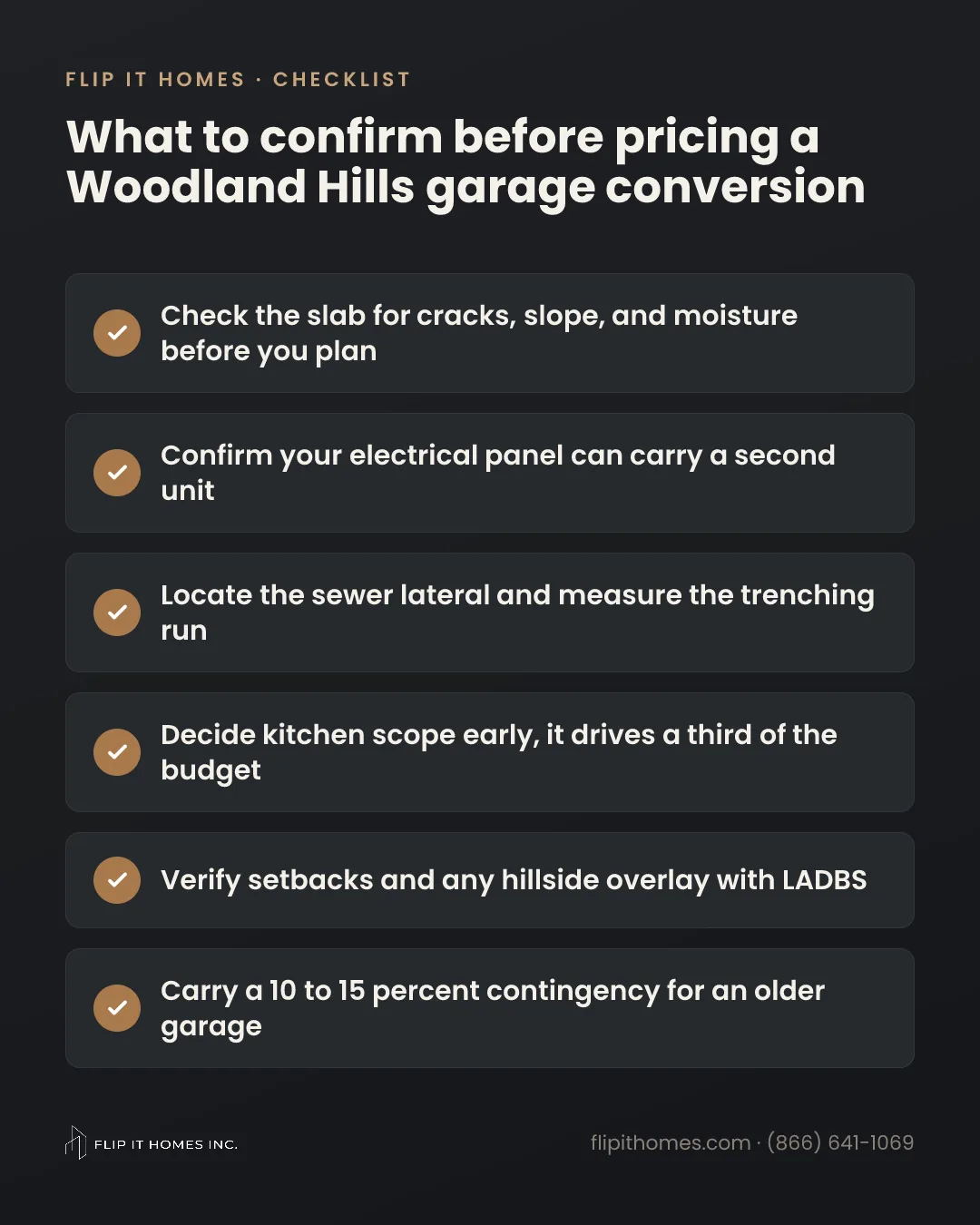
- Start with a feasibility walk. Slab, panel, sewer, and setbacks get checked before design begins.
- Lock the scope in writing. An itemized proposal that names fixtures and finish levels prevents drift.
- Order long-lead items early. Windows, the entry door, and appliances should be ordered the week permits are filed.
- Carry a 10 to 15 percent contingency. If the garage is older than 1980, treat the contingency as part of the real budget.
- Make finish decisions before drywall. Late tile and cabinet changes are the most expensive kind.
Is a Garage Conversion Worth It in Woodland Hills?
Woodland Hills is one of the strongest ADU markets in the Valley. Lots are large, rents for one-bedroom units are healthy, and converted garages rent quickly near Ventura Boulevard, Warner Center, and the schools that draw families to the area.
Against a 150,000 to 200,000 dollar investment, a legal rental unit typically generates meaningful monthly income and adds appraised value as a permitted dwelling. Families also use them for parents, adult kids, or a home office that keeps the main house intact. If you are weighing the options, our team has completed 150 plus projects across greater Los Angeles over 10 plus years, and we are happy to walk your garage with you. See our ADU and garage conversion services or request a free quote to get a real number for your lot.
Get a real number for your garage
A free on-site feasibility walk tells you what your conversion actually costs before you spend anything on design. We check the slab, panel, sewer, and setbacks and give you an itemized proposal.
Request a Free Quote